

Every LGPS fund in England and Wales is now partway through a job that starts with a list of deaths going back to December 2005. It ends with a payment to someone the fund may never have heard of.
Recalculating a widower's pension is a known task. Working out that the widower exists, finding where he lives twenty years on, and confirming he is alive before paying him arrears with interest is a different kind of work, and most of it sits outside the pension record.
What do LGPS funds have to do about survivor benefits?
The LGPS (Miscellaneous Amendments) (Member Benefits) Regulations 2026 equalise survivor pensions and backdate them to deaths from 5 December 2005. Under MHCLG's statutory guidance, funds in England and Wales must identify those deaths, trace and contact the survivors, and pay any arrears with interest by 1 January 2028. Finding the people is the hardest part.
What changed on 1 April 2026?
The regulations (SI 2026/226) were laid on 6 March 2026 and came into force on 1 April. They deliver the first phase of MHCLG's Access and Fairness consultation.
The starting point is Goodwin v Secretary of State for Education, a 2020 Employment Tribunal case in which the government accepted that the Teachers' Pension Scheme treated survivors differently by sexual orientation. Older LGPS rules had the same problem. A widow's pension counted all of the member's service, while a widower's pension from a female member counted a much shorter slice of it. A 2018 fix levelled up some groups but not all. The 2026 regulations finish the job, so survivors of spouses and civil partners now get the most generous comparable basis, whatever the sex of the member or the survivor.
The changes are backdated to the date each relationship was first legally recognised:
- deaths from 5 December 2005 for opposite-sex marriages and same-sex civil partnerships
- deaths from 13 March 2014 for same-sex marriages
- deaths from 31 December 2019 for opposite-sex civil partnerships
The regulations also formally remove the requirement for a cohabiting partner to have been nominated on a signed form, for deaths between 1 April 2008 and 31 March 2014. Most funds stopped enforcing it after Elmes v Essex County Council in 2018. Where a fund has not, the government expects it to put things right "as a matter of urgency". Separately, the age 75 cap on death grants goes, backdated to deaths from 1 April 2014.
Where a survivor is owed more, or is owed a pension for the first time, the fund pays the arrears with interest under regulation 81 of the 2013 Regulations. Interest runs at one per cent above base rate, calculated day by day from the date each payment was due.
What is the deadline for backdated survivor cases?
MHCLG published its statutory survivor benefits guidance on 1 April 2026, the day the regulations came into force. It sets four stages:
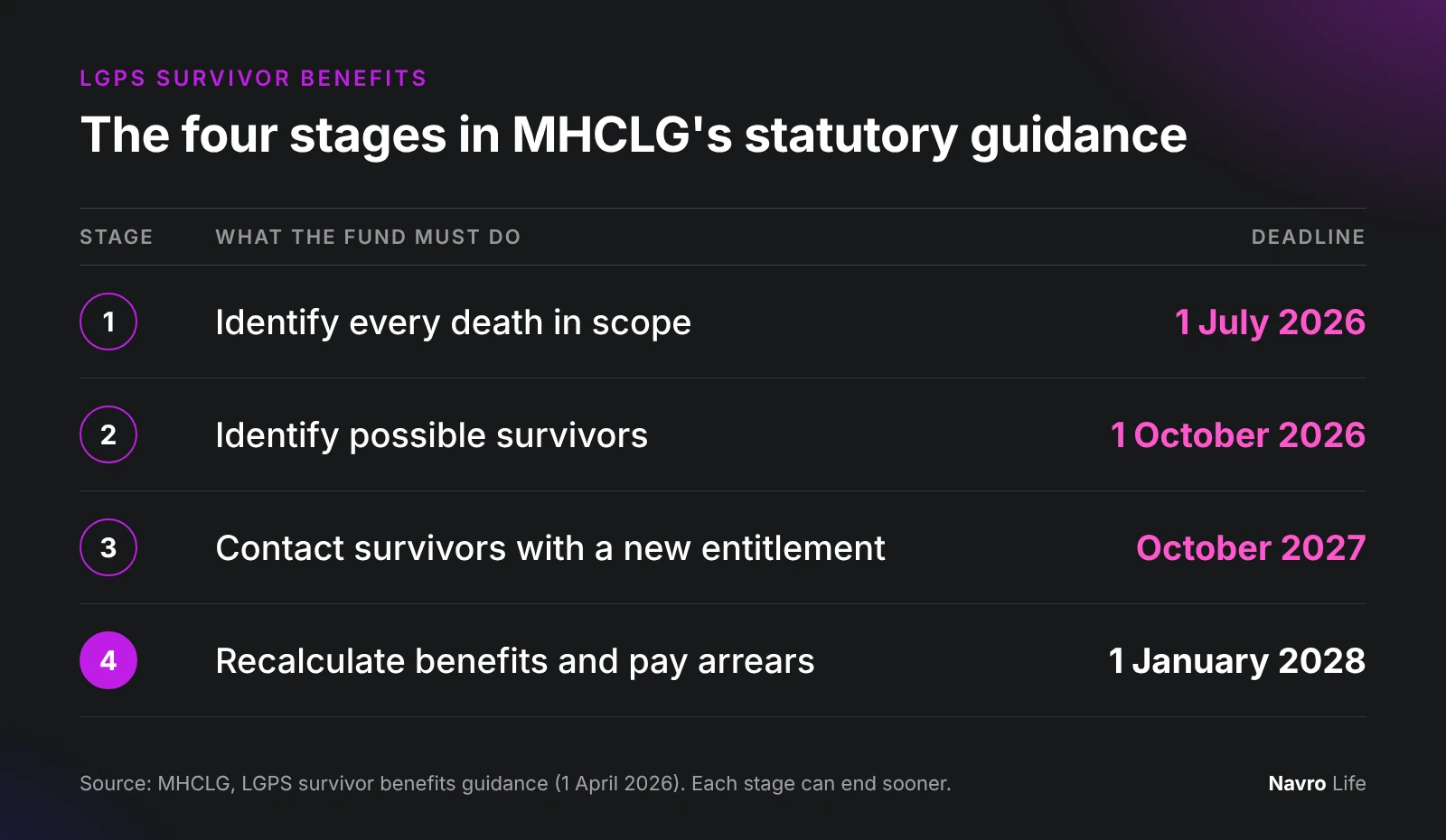
Each stage can finish sooner. The guidance sets each deadline as the earlier of the date shown and a fixed period after the previous stage ends. Backdated payments are expected "as soon as is practically possible, and in any event by 1 January 2028."
Stages one and two have already passed. A fund that met them is now in stage three, which runs for up to twelve months and is where the guidance gets most specific about effort.
What does "every reasonable effort" mean in practice?
The guidance says funds "must make every reasonable effort to identify, calculate the entitlement of, and make payment to those survivors." It then sets some minimum standards.
Where membership data is not enough, funds should "engage tracing companies to attempt to identify survivors." Anyone with a new entitlement must be contacted at least three times over twelve months, using both digital and physical methods. If a potential survivor does not respond to those attempts, and nothing else changes, no further action is expected.
Funds must not prioritise or park a case because of a protected characteristic or the size of the payment. They also have to be able to justify their approach to the overall caseload. Because of that last requirement, tracing becomes work a fund may later need to evidence to its pension board, its auditors or the Pensions Ombudsman.
Why is tracing LGPS survivors so difficult?
The Local Government Association set out the problem in its July 2025 response to the consultation. "The administrative impact will be significant," it wrote, and "pensions software is not designed to recalculate benefits going back a number of years." Expect manual work on most cases.
The data problem starts before any calculation. Records for older deaths "may have been archived and may not show any relationship status." The cases most likely to produce a brand-new entitlement involve male survivors of female members who left the scheme before April 1988, and those are the files most likely to be thin. With around 74 per cent of LGPS members being women, the LGA expects these reforms to "affect many more people than previous changes to survivor benefits."
Then there are the people. Someone whose partner died in 2006 has had twenty years to move house, remarry, change their name or emigrate. Some will have died. The guidance does not say what happens when a newly entitled survivor has since passed away, and the LGA has warned that some estates may need to be reopened. Writing to a bereaved family about a relationship that ended two decades ago also needs care. The LGA flagged the risk of upsetting relatives.
Paying the wrong person is its own risk. A backdated lump sum plus interest, sent to a contact detail that came from tracing, is an obvious target for fraud. Identity and existence checks need to happen before the money moves.
What else are LGPS administration teams dealing with?
Survivor benefits have not landed on an empty desk. The same teams are working through several other projects, each with its own deadlines:
- The McCloud remedy, which corrects age discrimination in the 2015 scheme changes by adding an underpin to affected members' benefits. Remedy work was due by 31 August 2025, and funds can extend it to 31 August 2026 where that is reasonable.
- Connecting to the national pensions dashboards. DWP guidance gave public service schemes a connect-by date of 31 October 2025, and keeping member data accurate and searchable carries on after connection.
- Reconciling guaranteed minimum pension (GMP) records with HMRC data, and equalising GMP amounts between men and women.
- Acting on the outcomes of the 2025 valuation, which set employer contribution rates from 1 April 2026.
- The government's Fit for the Future pooling reforms. Their regulations came into force on 30 June 2026 and move fund assets under the management of FCA-authorised pools.
Some of this work overlaps with survivor cases. McCloud recalculations also reach the survivors and estates of members who have died, with arrears and interest to pay, so a fund could find itself tracing the same family for two different projects.
The strain is on record. Minutes from the Local Government Pensions Committee's July 2025 meeting note concern about "the degree of work required to trace members where events had occurred up to 20 years previously", and a view that clear guidance was "desperately needed to avoid a non-uniform approach". With teams this stretched, survivor work competes for the same people and the same software changes as everything else. The parts that sit outside the pension record, such as tracing, verification and overseas payment, are the obvious ones to hand to a specialist.
What about survivors who live abroad?
The guidance does not mention survivors outside the UK, but over a twenty-year window some will have moved overseas. A survivor abroad creates three problems that a UK case does not.
The first is tracing. A UK address bureau will not find someone who emigrated in 2012. The second is verification: confirming that a person in another country is alive, and is the person on the file, before a backdated payment goes out. The third is payment. Arrears and a monthly pension sent from a UK account to an overseas bank can arrive late, or short after currency conversion and intermediary charges. That is a poor outcome for a survivor who has waited years for money they were always owed.
What does a defensible survivor benefits process look like?
Nobody will reach 1 January 2028 with perfect data. A fund can still build a process that stands up to scrutiny, and four things separate the funds that are on top of this from the ones still chasing it in late 2027.
The first is to trace with more than one source. Membership records start the search, but one bureau check against twenty-year-old data will leave gaps. Mortality screening, address tracing and relationship evidence each catch different cases.
The second is to log every attempt. Three contacts over twelve months, across digital and physical channels, need to be recorded with dates, methods and outcomes. If a fund later closes a case because nobody replied, that log is its evidence.
The third is to verify before paying. Arrears with interest should only go to someone the fund has confirmed is alive and is who they say they are. The same check applies to the survivor pension that follows.
The fourth is to plan for survivors overseas, so that arrears and ongoing pensions arrive in local currency, on time and in full.
Where Navro Life fits
Navro Life works with UK pension schemes and administrators on the parts of this process that sit outside the pension record. We trace members and beneficiaries, and our Proof of Life service confirms that the person being paid is alive. We then pay pensions to members and survivors wherever they live, in more than 140 currencies across 200+ territories, with same-day delivery in over 80 markets.
For survivor benefits, that means one partner for finding the survivor, confirming they are who and where the file says, and paying them, whether they live in Taunton or Toronto. Navro will be at the LGPS conference in Torquay on 17 and 18 November for any fund working through stage three that wants to compare notes.
Frequently asked questions
Which LGPS survivors are affected by the 2026 changes?
Survivors of spouses and civil partners whose pension was worked out on a less generous basis because of the sex of the member or the survivor. Male survivors of female members are the most affected group. Some will receive a pension for the first time, most likely where the member left the scheme before April 1988. Cohabiting partners of members who died between April 2008 and March 2014 no longer need a signed nomination form.
How far back do the LGPS survivor benefit changes go?
It depends on the relationship. The changes cover deaths from 5 December 2005 for opposite-sex marriages and same-sex civil partnerships, from 13 March 2014 for same-sex marriages, and from 31 December 2019 for opposite-sex civil partnerships.
Do survivors need to make a claim?
No. Funds must identify affected cases and contact survivors themselves. Anyone who thinks they are affected can still contact their LGPS fund directly.
Is interest paid on backdated survivor pensions?
Yes. Arrears carry interest under regulation 81 of the LGPS Regulations 2013, at one per cent above base rate, calculated daily from the date each payment was due.
What happens if a fund cannot find a survivor?
The guidance requires at least three contact attempts over twelve months, using digital and physical methods, and the use of tracing companies where the fund's own data is not enough. If a potential survivor still does not respond and nothing else changes, no further action is expected. The fund must be able to justify its overall approach.
Sources: SI 2026/226, The Local Government Pension Scheme (Miscellaneous Amendments) (Member Benefits) Regulations 2026 · Explanatory Memorandum to SI 2026/226 · MHCLG: LGPS survivor benefits guidance (1 April 2026) · LGPC Bulletin 276 (April 2026) · LGA and LGPC response to the Access and Fairness consultation (29 July 2025) · LGPC meeting minutes (21 July 2025) · MHCLG Access and Fairness government response (2 February 2026)