



Here's a scenario that will probably sound familiar to anyone who's worked in pension administration.
A member dies in March. The scheme is notified in April and confirms the survivor's entitlement in May. The calculation is right to the penny. The first payment goes out in June, to bank details nobody has checked, and comes back two weeks later because the account was closed.
The return lands in a queue and nothing flags it. The survivor rings in July to ask where the money is, and the person who answers can see the calculation but not what's happened to the payment.
It's a composite example, but I suspect plenty of people in pensions will recognise the situation.
I've spent a good part of my career working in pension administration and payments, and one thing I've learnt is that getting the calculation right is only part of the job. It's often the handovers between teams where things become difficult.
I also spend a lot of time talking to TPAs, in-house pension administrators and Heads of Pensions, and one thing that keeps coming up is the pressure on resources. There's already plenty to deal with, and the changes around survivor benefits are adding to that workload.
And while there's rightly a lot of focus on the regulatory and calculation side, I think we need to pay just as much attention to what happens when it's time to make the payment.
The short answer
Survivor benefits are a payments problem as much as a calculation one. From 6 April 2027, most pension death benefits fall into the member's estate for inheritance tax, while dependants' scheme pensions stay outside it. A single death can trigger several payments with different payees and deadlines, so schemes need one owner for the path from notification to cleared funds.
So what's actually changing?
Three developments matter here. They're different changes, but each has implications for how schemes administer survivor benefits and, ultimately, get money to the people entitled to receive it.
Inheritance tax changes from April 2027
From 6 April 2027, most unused pension funds and certain pension death benefits will be brought into the deceased member's estate for inheritance tax purposes, for deaths occurring on or after that date.
Dependants' scheme pensions and registered pension scheme death-in-service benefits are excluded, so the ongoing survivor's pension itself will generally sit outside the new arrangements. It's the lump sums and unused funds where much of the additional work will arise.
Personal representatives will be responsible for reporting and paying any inheritance tax due. Under the new arrangements, they can instruct a scheme to withhold up to 50% of certain lump sum death benefits for up to 15 months, or arrange for tax to be paid directly to HMRC under the relevant procedures. Schemes will also need to share information with personal representatives and beneficiaries to support the process.
HMRC has described several stages that may need to happen alongside one another, including establishing the benefits, sharing information, determining the tax position and arranging payments. So potentially more instructions, more information to exchange and more deadlines to manage. And of course, the scheme still needs to make sure the right beneficiaries receive the right amounts.
LGPS survivor pension equalisation
This is particularly relevant to some of the conversations I've been having with LGPS Heads of Pensions.
Following the Supreme Court's 2017 judgment in Walker v Innospec, survivor pension arrangements for same-sex spouses and civil partners have continued to evolve.
From 1 April 2026, changes to the LGPS in England and Wales mean administering authorities need to review historical cases, identify eligible survivors, recalculate entitlements and arrange backdated payments where appropriate. The government expects funds to make every reasonable effort to complete the retrospective exercise by January 2028.
Now, none of this is straightforward when you consider the age of some of the records. People may have moved, changed their details or be living overseas. In some cases, simply finding the right beneficiary could take time.
But the other thing I keep hearing is the pressure on resources. Speak to an LGPS Head of Pensions and there's already a long list of priorities. Dashboards, McCloud, data quality and day-to-day administration are all competing for attention. And it's not just the LGPS. I'm hearing similar concerns from TPAs who are managing administration across multiple schemes, often with different processes, systems and client requirements. It's not necessarily that people don't know what needs to be done. It's finding the capacity to do it all.
Once you've tracked down the beneficiary, established their entitlement and calculated any arrears, you still need to get the money to them. The last thing anyone needs at that point is a failed payment and another round of manual investigation.
Pensions dashboards and the survivor benefit flag
There's also the survivor benefit flag in pensions dashboards. PASA issued guidance in June 2026 to help schemes apply it consistently, following different interpretations of the requirements. The flag indicates whether a pension provides benefits for a spouse or dependant after the member dies.
It's another area where schemes need to make sure the information they're providing is accurate and consistent.
And as members start to see more of this information, there may well be more questions for administrators about what survivor benefits are available and how they work. On its own, this might not sound like a major issue. But alongside everything else, it's another consideration for teams that are already busy.
One death, several payments
A single death can result in several different payments.
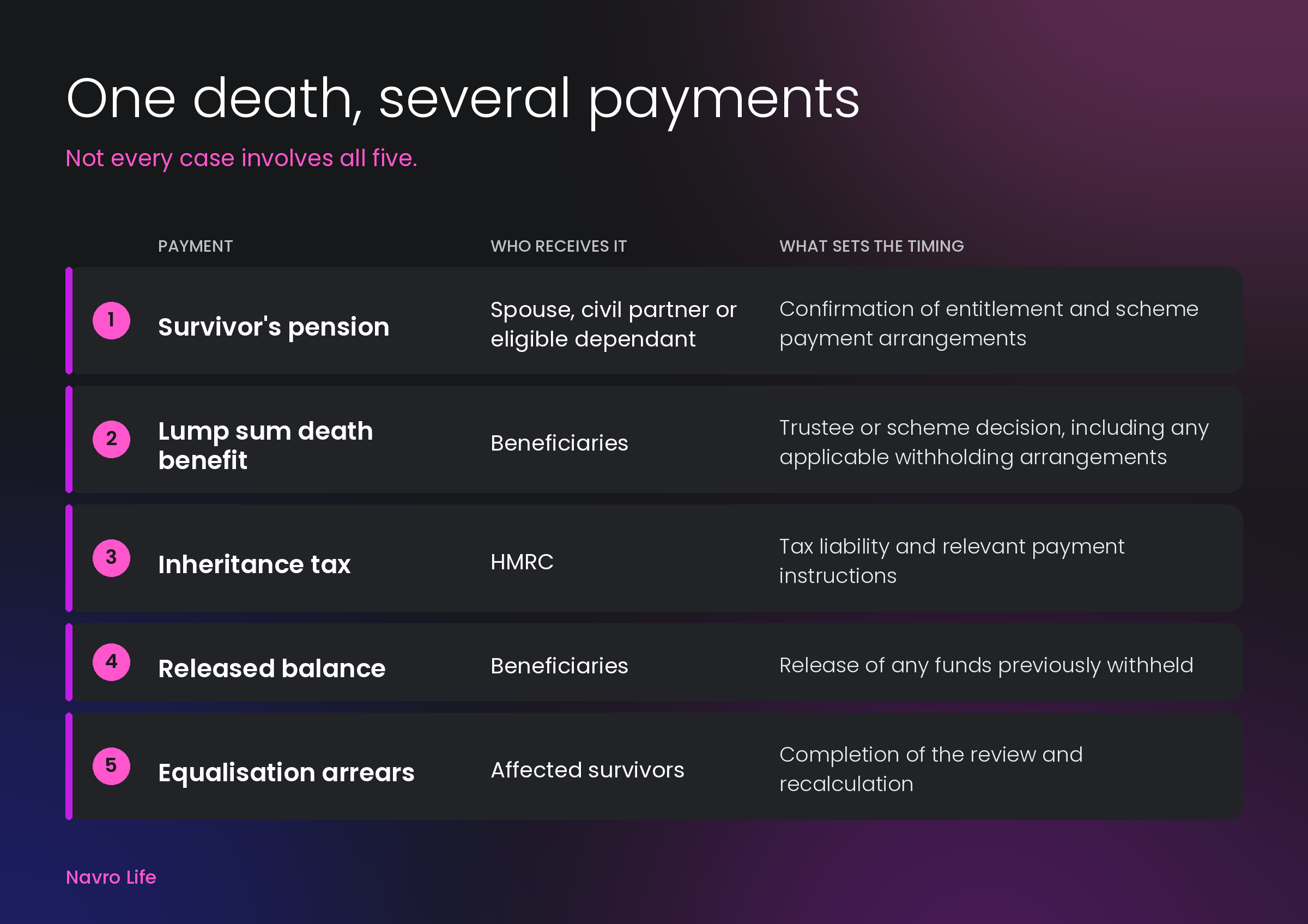
Depending on the circumstances, you could have:
- Survivor's pension: paid to the spouse, civil partner or eligible dependant, with timing set by confirmation of entitlement and scheme payment arrangements.
- Lump sum death benefit: paid to the beneficiaries, with timing set by a trustee or scheme decision, including any applicable withholding arrangements.
- Inheritance tax: paid to HMRC, with timing set by the tax liability and relevant payment instructions.
- Released balance: paid to the beneficiaries, with timing set by the release of any funds previously withheld.
- Equalisation arrears: paid to affected survivors, with timing set by completion of the review and recalculation.
Not every case will involve all of these, but you can see how quickly things can become complicated. Different people receive different amounts, potentially in different countries, with different requirements and deadlines.
And in many pension administration operations, different teams are involved at each stage. One team deals with the notification, another confirms entitlement, someone calculates the benefit and another team or provider handles the payment.
That's not necessarily a problem. It's how administration has worked for years. But what happens when a payment doesn't arrive? Who picks it up? Who knows why it's failed? And how quickly can someone give the beneficiary an answer?
Those are the sorts of questions that become important when you're trying to manage an already busy administration operation.
How do schemes find out a member has died?
It starts with how a scheme finds out that a member has died.
Before a survivor benefit can be put into payment, the scheme needs to know about the death and establish who may be entitled to receive benefits.
For UK pensioners, there are established notification and mortality data processes. But for members living overseas, things can be more complicated.
Notification of a death doesn't always arrive promptly. In the meantime, pension payments may continue, creating overpayments that administrators then need to investigate and potentially recover.
And as anyone who's worked in pension administration will know, recovering overpayments after a member has died is rarely straightforward. This is where more regular, digital life verification and mortality screening can help. They can provide greater confidence that pensions are being paid to living members, help identify potential deaths earlier and reduce the risk of overpayments.
Where a death is confirmed, that can also help the administrator start the survivor benefit process sooner. It's something we're also focused on at Navro Life, because verifying that payments should continue and making sure they reach the right person are closely connected.
The payment side is often overlooked
There's rightly a lot of attention on getting the entitlement and calculation correct. But I do think we sometimes overlook what happens after the payment has been authorised. Take an overseas survivor, for example.
They may be receiving a payment from the scheme for the first time. Their bank details may never have been checked, and depending on where they live, there may be additional requirements around account information, tax identification numbers or payment purpose codes. If those details aren't captured properly at the start, the payment can be rejected or returned. Then someone has to investigate what happened, contact the beneficiary, correct the details, arrange another payment and reconcile everything.
That's more work for the administrator and another delay for the survivor. And it can be surprisingly difficult to get a clear picture of where a payment is once it's left the administration system. Was it sent? Has it reached the receiving bank? Has it been credited? Has it been returned? These are fairly basic questions, but the answers aren't always immediately available.
And we shouldn't overlook fraud
There's also the fraud angle to consider. With survivor benefits, you're often dealing with someone the scheme hasn't paid before. That means establishing who they are, confirming they're entitled to receive the benefit and making sure the payment details are genuine.
There's a risk of impersonation, fraudulent changes to bank details or payments being redirected to the wrong account.
It's not just about having the right controls in place. It's making sure those controls work without creating unnecessary delays for genuine beneficiaries. Particularly when someone is dealing with a bereavement, the last thing they need is a complicated process or repeated requests for information.
For overseas payments, where verifying details and resolving problems can be more difficult, getting that balance right is especially important.
Why this matters for TPAs, beneficiaries and trustees
One thing that comes through in my conversations with TPAs is the amount of time that can be spent dealing with exceptions.
A returned payment might not sound like a big issue on its own, but someone has to investigate it, work out what happened, contact the beneficiary, correct the details and arrange another payment. Multiply that across hundreds of schemes and thousands of payments, and you can see why it matters.
And when you add in death notifications, life verification, potential overpayments, fraud checks and survivor benefit calculations, there's a lot for administration teams to manage.
This is where I think there's a real opportunity to make life easier for administrators. Not by adding another system or process, but by taking some of the manual work out of the payment stage and improving how information flows between the different parts of the operation.
And of course, it's not just about saving time. For the survivor, the experience is much simpler. They want to know how much they're going to receive, when it's coming and that someone can help if there's a problem. We talk a lot about improving member experience in pensions, and rightly so. But surely making sure people actually receive their money is one of the most important parts of it. Particularly when you're dealing with someone who has recently lost a partner or family member.
There's also a trustee perspective. Trustees and pension committees need confidence that benefits are being paid correctly, particularly where administration and payments are outsourced. Knowing that a calculation has been approved or a payment file submitted is useful, but it doesn't necessarily tell you whether the money has reached the beneficiary. Being able to track the payment, identify any problems and demonstrate what happened gives trustees a much clearer picture of how the process is working.
It's not about adding another layer of reporting for the sake of it. It's about having the information available when it's needed.
Where Navro Life fits in
This is the area we're focused on at Navro Life.
We're not replacing pension administrators or changing how schemes decide entitlement and calculate benefits. That's their job. What we're doing is helping schemes manage the payment side more efficiently, while also looking at how life verification can support better controls earlier in the process.
On the payments side, Navro Life supports payments across more than 200 territories and 140 currencies, with same-day delivery available in over 80 markets.
Member and bank details can be validated upfront, and country-specific payment requirements captured before the money is sent. FX rates are fixed at instruction, with no unexpected intermediary deductions within our supported payment arrangements, so there's greater certainty over what the beneficiary will receive.
Administrators have access to real-time payment, credit and debit notifications, rather than having to chase updates. If a payment fails or is returned, it can be retried or sent back to the scheme automatically, with information about what's happened.
Each scheme has a dedicated funding account, which helps with reconciliation, and sanctions screening and AML checks are built into the process. There's also a dedicated client service manager who understands pension operations, so administrators have someone to speak to when they need support. And importantly, this can all sit alongside existing pension administration platforms through a single integration.
Alongside this, our work on digital life verification is focused on helping schemes establish whether pensioners are still living, particularly those overseas, and reducing the risk of payments continuing after death. These are two different parts of pension administration, but they're closely connected.
The sooner a death is identified and confirmed, the sooner the appropriate administration can begin. And once a survivor's entitlement has been established, the payment needs to be made securely, accurately and with clear visibility over its progress.
For TPAs and in-house teams, that means less manual intervention and fewer payment issues to investigate. For trustees, better visibility and stronger controls. And for beneficiaries, greater certainty that their money will arrive as expected.
One question I'd be asking
With the LGPS survivor pension changes already underway and the inheritance tax reforms coming in April 2027, I think it's worth schemes taking a look at how they manage death benefit cases from start to finish. Not just the entitlement and calculation, but everything from identifying and confirming the death through to making sure the survivor receives their money.
There's one question I'd be asking at the next trustee or pension committee meeting:
How long does it actually take from notification of death to the first survivor payment arriving, and who owns that number?
I'd be interested to know how many schemes can answer that easily. Because from my experience, it's often the bits between the established processes that create the most work. And with administration teams being asked to do more, finding ways to reduce that work has to make sense.
It's something we've talked about at Navro Life in the context of the Last Mile of Retirement. Making sure payments stop when they should, identifying when survivor benefits need to begin, and getting the right money to the right person.
For administrators, that means a more efficient process. For beneficiaries, it's about knowing their money will arrive. And for trustees, it's having confidence that everything has worked as it should.
That's ultimately what we're trying to help deliver at Navro Life.
Frequently asked questions
What are pension survivor benefits?
Survivor benefits are payments made to a member's spouse, civil partner, eligible partner or dependants after the member dies. They can take the form of an ongoing pension, a lump sum, or both. In defined benefit schemes the survivor's pension is commonly a proportion of the member's own pension, paid for life, though each scheme's rules set the detail.
Will survivor pensions be subject to inheritance tax from April 2027?
Mostly no. For deaths on or after 6 April 2027, dependants' scheme pensions and death in service benefits are excluded from the new inheritance tax rules, while most lump sums and unused funds are brought into the member's estate. What counts as a dependant is defined by each scheme, so the boundary varies.
What can personal representatives ask a pension scheme to do under the new rules?
From April 2027 personal representatives can instruct a scheme to withhold up to 50% of a lump sum death benefit for up to 15 months. They, or the beneficiaries, can also direct the scheme to pay inheritance tax straight to HMRC. Schemes will need to share information with personal representatives to make this work.
What is the survivor benefit flag in pensions dashboards?
It is an indicator in dashboard value data showing that a pension provides benefits to a spouse or dependant after the member's death. PASA published guidance in June 2026 to help schemes and providers apply the flag consistently, because the existing guidance had been read in different ways.
What is the deadline for LGPS survivor pension equalisation?
The government expects LGPS administering authorities in England and Wales to make every reasonable effort to complete the backdated payments as soon as is practically possible, and in any event by 1 January 2028. Deaths from 1 April 2026 are calculated on the equalised basis.
Why are survivor payments harder to get right than regular pension payments?
The survivor is a new payee. Their bank details have usually never been validated, they may live in a different country from the member, and a single death can trigger several payments with different amounts and deadlines. A failure on the first payment also lands at the point when the recipient is least able to chase it.
Why does life verification matter for survivor benefits?
A scheme cannot start a survivor benefit until it knows about the death. Notification does not always arrive promptly, particularly for members living overseas, and pension payments may continue in the meantime, creating overpayments that are hard to recover. Regular digital life verification and mortality screening can help identify deaths earlier and reduce that risk.
How can schemes reduce failed or delayed survivor payments?
By validating payee and bank details before the payment date, capturing country-specific data upfront for overseas survivors, giving every payment a visible status, and handling returns automatically instead of by email. A dedicated funding account for each scheme also keeps reconciliation tied to the individual case.
This article is general information, not legal or tax advice.

