

The money is starting to flow the other way
For most of their short history, DC master trusts have been built to take money in. Auto-enrolment gave them a steady inbound flow of employer payroll files, contribution schedules and monthly reconciliations. The administration platforms, the service agreements and the board agendas all grew up around accumulation.
The FCA's latest retirement income data shows that £91.2bn was withdrawn from pension pots in 2025/26, an increase of 21.7% on the previous year. The scale of money moving out of pension savings is growing, and so is the importance of the infrastructure that supports retirement payments. Master trusts are already where most UK workers save. Over the next few years they become one of the main ways UK retirees get paid.
A scheme that pays out runs differently from one that collects. It sends money to hundreds of thousands of individual bank accounts, on dates members plan their lives around, and some of those accounts are in other countries and other currencies. A late contribution means a letter to an employer. A late pension payment can mean a 74-year-old in Málaga missing her rent. The rest of this post looks at what that shift asks of master trust payments infrastructure, and why trustees should treat it as a governance question now, years before the guided retirement duty applies to them.
Scale has arrived, and the Act wants more of it
TPR's 2025 DC landscape figures show 790 DC schemes left in the market, down 15% in a year. Master trusts hold 30.1 million memberships, 92% of all DC members, and £208bn, or 83% of DC assets. Richard Knox, TPR's executive director for strategy, policy and analysis, said it without hedging: "As we move towards a market of fewer larger schemes, master trusts now dominate." (TPR, March 2026)
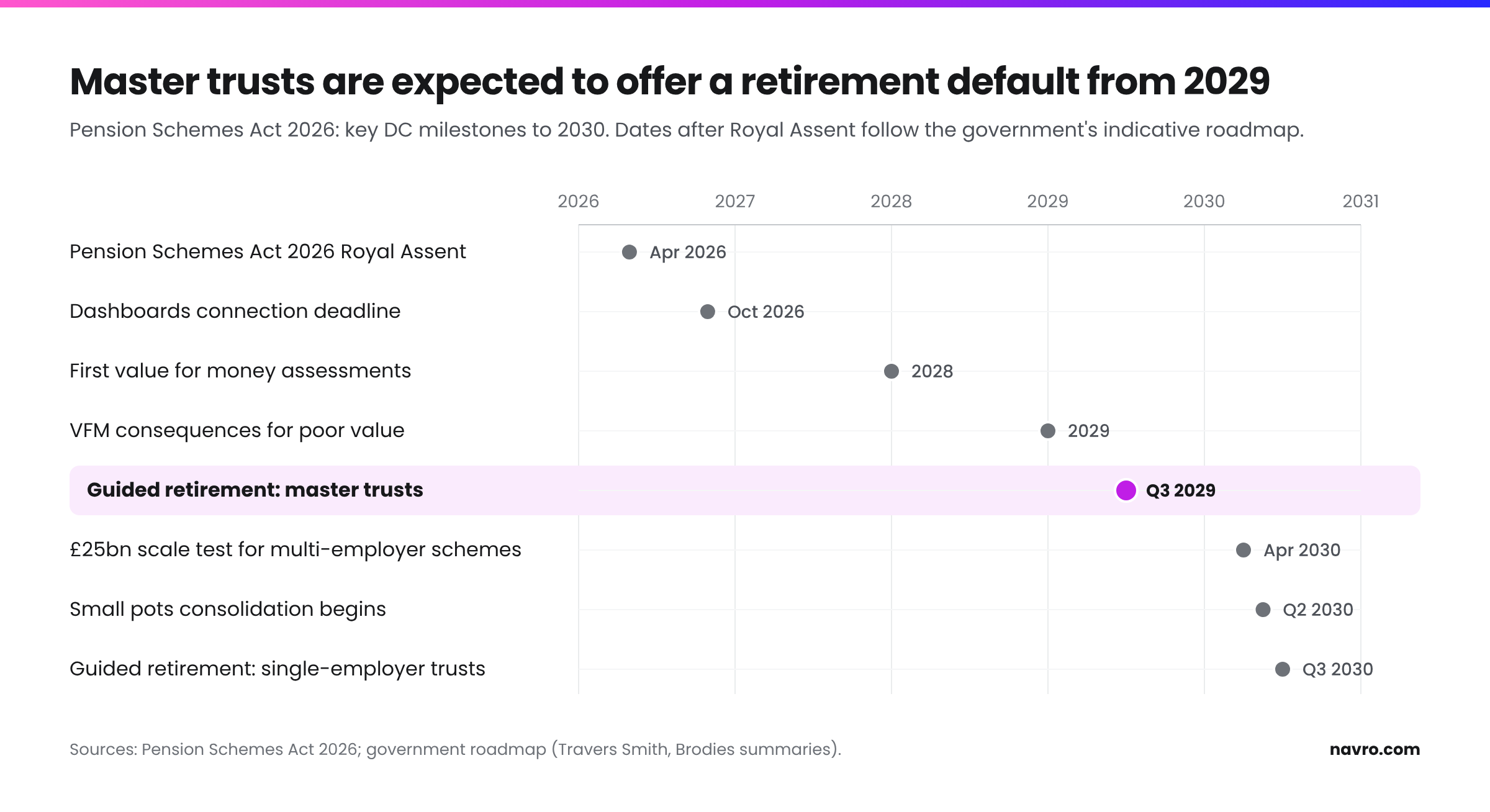
The Pension Schemes Act 2026, which received Royal Assent on 29 April, pushes the market further in the same direction, although many of its requirements will be introduced over the coming years through secondary legislation. From April 2030, multi-employer DC schemes used for automatic enrolment will generally need at least £25bn in a main scale default arrangement, subject to exemptions and transitional provisions. A transition pathway is envisaged for schemes with at least £10bn and a credible growth plan. Dormant pots under £1,000 will be swept into a small number of government-approved consolidator master trusts. Value for money assessments begin in 2028, with consequences for poor performers from 2029.
Consolidation moves members as well as assets. Bulk transfers can bring records of varying quality, including outdated contact details, historic bank information and inconsistencies between administration systems. As master trusts grow through consolidation, checking and maintaining that information becomes increasingly important. The Pensions Policy Institute estimates 3.3 million lost pots worth £31.1bn already sit in the system. Pensions dashboards will help people find them; more than 70 million records were connected by May, ahead of next week's 31 October connection deadline, with public launch expected in 2027/28. Every pot that gets found will eventually need paying out, often to someone the scheme has never spoken to.
Decumulation is becoming a master trust product
TPR's analysis of 2025 scheme returns found that 13.4 million members are now offered drawdown at retirement, and 43% of members can take it without leaving their scheme. TPR credits master trusts with most of that growth. Nest, with more than 14 million members, was given powers in May to offer flexi-access drawdown, something the DWP declined to allow in 2017.
The Act's guided retirement provisions will require relevant schemes to make default pension solutions available, designed to provide members with an income in retirement. Under the government's current, indicative roadmap, master trusts are expected to comply from the third quarter of 2029, with single-employer trusts following in 2030. Schemes are already considering how those solutions will work in practice. The largest providers are building their propositions now.
Drawdown changes the shape of a scheme's payments. A lump sum is one transfer. A drawdown income is a payment every month for 20 or 30 years, with ad hoc withdrawals on top, tax deducted at source, and a death benefit at the end that may go to a spouse, a child or an estate in another jurisdiction. Spread that across hundreds of thousands of members and a master trust is running a monthly payroll for retirees. Those members will expect the same accuracy and timing they used to get from their salary.
Some of them will not be in the UK. The DWP pays the State Pension to around 1.1 million people living overseas, and more than a million UK occupational scheme members live abroad. Auto-enrolment adds a newer group: people who worked in the UK for a few years, built a modest pot, and went home to Poland, India, Portugal or Australia. Their scheme may hold nothing more recent than the UK bank account they closed when they left.
Where the payment chain breaks
Most schemes pay retirees through their administrator's banking arrangements. Typically that means a UK clearing bank and a Bacs file, with a correspondent bank or FX provider added later for the overseas cases. These arrangements can work well for established domestic pension payrolls. But as decumulation volumes grow, particularly where members live overseas or require more flexible payments, six areas deserve closer attention.
Overseas payments can arrive late, with unexpected deductions, or occasionally fail altogether. Where payments rely on correspondent banking arrangements, intermediary charges and settlement times can create uncertainty for administrators and members alike. The challenge is not simply getting the payment away, but knowing when it has arrived and exactly how much the member has received. Settlement can take several days. When a payment goes missing, tracing it means emails between banks that neither the scheme nor the member can see.
FX is opaque to everyone except the bank. The exchange rate is set at the point of conversion, the spread is rarely itemised, and the trustee report shows sterling out. What the member actually received in euros or rand is a number the scheme often does not hold.
Returned payments pile up. Closed accounts, mistyped IBANs and records inherited from bulk transfers all produce returns. Each one means investigation, member contact, fresh bank details and a reissue, usually by hand, while the member goes without.
Payments can continue after a member has died, particularly where notification is delayed or the member lives overseas. Even with existing mortality controls, these cases can be difficult to identify promptly, and recovering overpayments from overseas accounts may be costly or unsuccessful. Each case also means a difficult conversation with a bereaved family.
Fraudsters target the point of change. Action Fraud received 519 reports of pension fraud in 2024, with £17.6m lost and an average loss of £33,848. A change-of-bank-details request is the obvious place to attack a decumulating member, and it is the moment schemes have least visibility of who is asking.
A single bank is a single point of failure. The Treasury Committee found that nine large UK banks and building societies logged more than 33 days of unplanned outages and at least 158 IT incidents between January 2023 and February 2025. During the Barclays outage at the end of January 2025, more than half of attempted online payments failed, right around payday. A scheme that sends one payment run, through one bank, on one date each month carries all of that risk.
Why payments belong on the trustee agenda
Payments have usually sat with the administrator, governed by a service level agreement and rarely raised at board level unless something has gone wrong. The Act makes that position harder to hold, for three reasons.
The new Value for Money framework will bring greater transparency to investment performance, costs and charges, and quality of service. Although its initial focus is on accumulation, the direction of travel is clear: schemes will face greater scrutiny over the outcomes and service they deliver. As decumulation grows, payment accuracy, timeliness and member experience should become increasingly important measures of that service.
Guided retirement makes the payout journey the trustees' own design. Trustees choose the default, keep it under review and stand behind it. A default that pays a member in Portugal four days late, after an FX spread nobody disclosed, is a weaker default, and the trustees' name is on it.
TPR's General Code already expects an effective system of governance, with operational and outsourcing risks identified and managed. Payments infrastructure is an outsourced operational risk with direct member harm attached. As Navro CEO Aran Brown has put it, trustees "are under increasing pressure to demonstrate that they are taking reasonable, proactive steps".
What reliable payments infrastructure looks like
Reliability, for a scheme paying retirees, has a fairly precise meaning. The member receives the amount the scheme intended, in her own currency, on the date she was told, and the scheme can prove it afterwards. Most of what follows comes from working backwards from that standard.
Payments should travel on local rails wherever they exist. Paying a member in France through the domestic SEPA system, or a member in India through its national rails, removes the correspondent chain and the deductions that come with it. The payment lands as a local credit, at the value sent.
The FX rate and the amount the member will receive should be known before the payment is released. Trustees can then disclose it, administrators can answer the member's question on the first call, and nobody discovers a shortfall from a complaint.
Every payment needs a status the administrator can see, from instruction to credit. When something fails, the reason should come back in a form that can be acted on, so a closed account triggers a re-contact workflow on the same day rather than a manual investigation the following week.
Bank details should be validated before the first payment and again whenever they change. For overseas members, schemes should have appropriate identity and Proof-of-Life controls, particularly when payments begin, member details change or existing verification becomes outdated. Where possible, these checks should complement the payment process rather than create unnecessary additional administration.
The scheme should not depend on one bank. Access to more than one banking partner can reduce dependence on a single provider and improve resilience. However, effective contingency planning still matters, particularly when payments are time-critical and members rely on them for everyday living costs.
All of this should reach the administrator through one integration. Asking an administration team to manage a separate bank, FX provider, tracing agency and verification service for its overseas book adds four contracts, four data flows and four places for a record to go out of date.
Where Navro Life fits
Navro Life is the pensions payments infrastructure Navro built for schemes, administrators and the platforms they run on. It plugs into the administration platform through one API, under one contract, and pays members in 140+ currencies across 200+ territories, with same-day settlement in 80+ markets over local rails.
Behind that single integration, Navro curates a network of banking and payments partners. The scheme does not need a separate correspondent arrangement for each region, and payment routes are spread across partners instead of resting on one bank. The administrator instructs a payment run in sterling and sees each payment through to the member's account, with the FX rate and delivered amount fixed before release.
For overseas members, Navro Life includes Navro Proof of Life. A member completes existence and identity verification as part of the payment journey, so the scheme knows it is paying a living, correctly identified person before the money leaves. Trustees get reporting on who has been verified and when, which is the evidence of reasonable steps that a regulator or auditor will ask for.
None of this changes who runs the scheme. Administrators retain their platforms, their member relationships and responsibility for delivering the service. Navro Life helps strengthen what we call the Last Mile of Retirement, where accurate member information, appropriate verification and reliable payment execution come together. Because ultimately, it's not just about building someone's pension pot. It's about making sure the right pension reaches the right person, at the right time, with the evidence to prove it.
That's the pension promise.
Seven questions for your administrator this year
Master trusts have roughly three years before guided retirement applies, and the largest are already paying drawdown income. A useful place to start is a short set of questions put to the administrator before the next board meeting.
- What share of payments to overseas members arrived in full, on the intended date, last year? How do we know?
- For every £1,000 we send to a member in Spain, what does she receive, and who sets the exchange rate?
- How many payments were returned in the last 12 months, and how long did each take to resolve?
- How do we confirm overseas members are alive before we pay them, and how often?
- What checks run when a member asks to change their bank details?
- If our bank's systems are down on payment day, what happens to the run?
- Will the current set-up handle our expected decumulation volumes in 2029?
If the answers come back vague, that tells the board something too. Accumulation let schemes treat payments as plumbing. Once a scheme is paying incomes for life, the payment is the part of the service every member sees.
As master trusts prepare for the next phase of retirement provision, now is a good time to ask whether their payments infrastructure is ready for the journey ahead. Find out more about Navro Life.
Sources: TPR: Master trusts dominate as smaller schemes continue to exit the DC market (March 2026) · TPR: New data signals landmark shift from savings system (March 2026) · FCA: Retirement income market data 2025/26 · Brodies: The Pension Schemes Act 2026, a summary of key changes · Travers Smith: What's happening in DC, Pension Schemes Act 2026 special · Pensions Expert: Nest granted drawdown capabilities ahead of guided retirement push · Pensions Policy Institute: Lost pensions 2024 · AJ Bell: Over 70 million pension records connected to dashboards (May 2026) · Parliamentary written answer: State Pension recipients abroad (March 2026) · Police Professional: Pension fraud losses in 2024 · Morningstar: Barclays to pay up to £12.5m compensation; Treasury Committee outage figures